

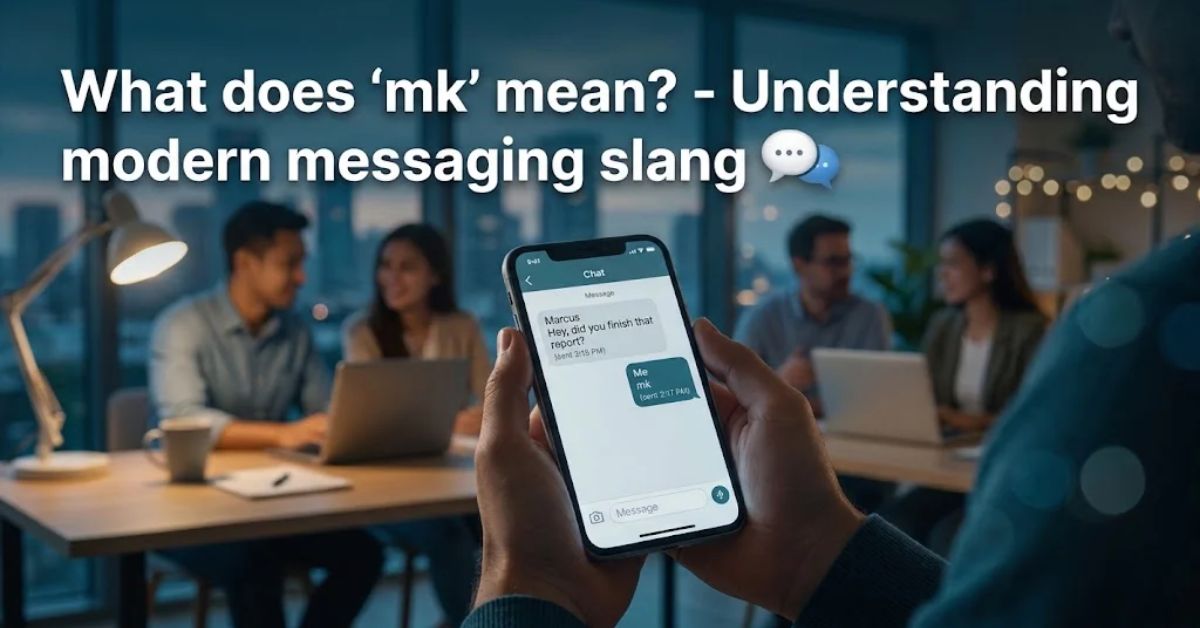
Have you ever received a message that simply says MK and wondered what the person really means? This tiny two-letter reply appears everywhere in texting, chats, and social media, but its meaning is not always obvious. The mk meaning text is usually linked to Okay, Mmkay, or Got it. It often shows agreement, understanding, or a quick acknowledgment.
However, MK is not always as simple as it looks. The meaning can shift depending on the conversation, tone, punctuation, and relationship between the people chatting. Sometimes it feels friendly and casual. In other situations, it may seem cold, unsure, or even dismissive. From WhatsApp and Instagram DMs to TikTok comments and private chats, knowing the context helps you understand what someone truly means when they send MK.
Meaning & Definition
When someone sends MK meaning text, they usually refer to a short way of saying “Okay” or “Mmkay.” It works as a quick acknowledgment in casual conversations.
People use MK to show that they understand something, agree with a plan, or simply received a message.
The meaning can change based on the conversation. A simple “MK” from a friend may feel normal, while the same reply during an argument might sound cold or dismissive.
Common meanings include:
- Okay
- Mmkay
- Got it
- Understood
- Message received
- Message acknowledged
- Sounds good
For example:
Person A: I’ll send you the details tonight.
Person B: MK.
Meaning: “Okay, I understand.”
However, context matters. The sender’s tone, relationship, and texting habits can change how you read the message.
Definition
MK is an informal texting abbreviation used in digital communication. It appears in text messages, chats, and social media conversations.
The term works as a short reply that shows acknowledgment or agreement without writing a full sentence.
In most cases, MK means:
- I understand.
- I agree.
- I received your message.
- I’m okay with that.
The mk meaning text explanation depends on the situation where someone uses it.
For example:
Person A: Remember to bring the documents tomorrow.
Person B: MK.
Here, MK means “Got it” or “Understood.”
People often use MK because it saves time. It fits the fast style of mobile messaging and online conversations.
Full Form
MK does not have one official full form in texting. However, most people use it as a casual version of “Mmkay” or “Okay.”
The common interpretations include:
- Mmkay
- Mm-kay
- Okay
- Message acknowledged
“Mmkay” sounds like a spoken version of “okay.” People often write it online to add a more conversational feeling.
For example:
Person A: Are you ready to leave?
Person B: MK.
This can simply mean “Okay, I’m ready.”
Unlike some texting abbreviations, MK is not always an acronym. It is more like a shortened sound or informal spelling used in casual communication.
Common Interpretation
Most people understand MK as a simple acknowledgment. It usually shows agreement, confirmation, or understanding.
Common interpretations include:
- “Okay.”
- “Sure.”
- “Alright.”
- “Yup.”
- “Sounds good.”
- “I understand.”
However, the feeling behind MK depends on the context.
A friendly conversation may make MK sound positive.
Person A: Let’s meet at 7 after work.
Person B: MK 😊
Meaning: “Sounds good.”
But a short reply in a serious conversation may feel different.
Person A: I already explained this yesterday.
Person B: MK.
Here, it may sound like a low-energy reply or a sign of irritation. The word itself does not show annoyance. The surrounding conversation creates that feeling.
Real-World Examples
MK appears in many everyday conversations. People use it in text messages, private chats, group chats, and social media.
Example 1: Making plans
Person A: Meet me outside the restaurant at 8.
Person B: MK.
Meaning: “Okay, I’ll be there.”
Example 2: Receiving information
Person A: The meeting starts at 10 AM.
Person B: MK, thanks.
Meaning: “I got it.”
Example 3: Online chat
Person A: Check the new update when you have time.
Person B: MK.
Meaning: “Understood.”
You may also see different styles:
- MK! → Can show enthusiasm.
- MK? → May ask for clarification.
- MK… → Can suggest hesitation or uncertainty.
The meaning changes with punctuation, capitalization, emojis, and texting style.
Background
MK became popular because online communication favors short and fast messages. As people started using mobile phones, instant messaging, and social networking platforms more often, texting abbreviations became common.
Like LOL, BRB, IDK, and IMO, MK developed as part of internet slang and short-form messaging culture.
It helps people reply quickly without typing long sentences. However, the exact meaning still depends on context, relationship with the sender, and conversation history.
Origin of MK
The origin of MK comes from casual speech and internet shorthand. People started writing shorter versions of common words to make digital communication faster.
Instead of typing:
- Okay
- Alright
- I understand
- Got it
Users created shorter replies like:
- K
- KK
- MK
The mk meaning text usage became popular because “Mmkay” sounded like a natural spoken response.
For example:
Person A: Can you check this later?
Person B: MK.
The reply feels quick and casual.
MK does not come from a formal abbreviation system. Instead, it grew naturally through texting culture, online chats, and everyday conversations.
History
The history of MK connects with the growth of SMS texting and online messaging.
When mobile messaging became popular, people wanted faster ways to communicate. Short replies became a normal part of digital conversations.
During the growth of:
- SMS messages
- Instant messaging
- Chat rooms
- Social networking platforms
Users created many shorthand expressions.
Examples include:
- LOL for laughing
- BRB for leaving temporarily
- IDK for “I don’t know”
- IMO for “in my opinion”
MK followed the same trend. It became a convenient way to acknowledge messages without writing a complete response.
Over time, people also started using MK on WhatsApp, Instagram DMs, TikTok comments, and gaming chat.
Evolution
The meaning of MK has changed slightly as digital communication has evolved.
At first, people mainly used it as a simple replacement for “okay.” Today, the tone can vary depending on the situation.
Modern uses include:
- Friendly acknowledgment
- Quick response
- Casual agreement
- Confirmation
- Uncertain acceptance
For example:
Person A: Want to try the new game tonight?
Person B: MK!
This may sound excited.
But:
Person A: We need to discuss this problem again.
Person B: MK…
The ellipsis can create a feeling of hesitation or reluctance.
The evolution of MK shows how texting abbreviations gain extra meanings through tone, punctuation, emojis, and personal communication patterns. It remains a simple but flexible part of modern online conversations.
Evolution
The mk meaning text has changed as online communication has grown. At first, people mostly used MK as a simple replacement for “okay” or “mmkay.”
Over time, users started adding different emotions to it. The meaning now depends on the conversation, punctuation, and texting habits.
Today, MK can express:
- Agreement
- Understanding
- Quick response
- Confirmation
- Hesitation
- Reluctance
For example:
Person A: We need to leave early tomorrow.
Person B: MK.
This sounds like a normal acknowledgment.
However, the same word can feel different with changes in style:
Person B: MK…
The ellipsis may suggest uncertainty or hesitation.
As texting culture continues to evolve, short replies like MK, LOL, BRB, and IDK keep changing based on how people communicate online.
Why People Use It
People use MK because it is short, convenient, and easy to type. In fast digital communication, many users prefer quick replies instead of full sentences.
The mk meaning text usage fits naturally into casual conversations because it saves time while still showing a response.
Common reasons people use MK include:
- Faster communication
- Casual conversation style
- Simple acknowledgment
- Avoiding long replies
- Showing they received a message
For example:
Person A: I sent you the link.
Person B: MK.
Here, MK means “Got it” or “Message received.”
People often use it in:
- Text messages
- Instagram DMs
- Group chats
- Gaming chat
- Online communities
However, MK usually works best in informal conversations. For professional communication, words like “Understood” or “Acknowledged” sound clearer.
Is MK Rude in Texting?
MK is usually not rude in texting. Most of the time, it simply means “Okay,” “Got it,” or “I understand.”
The word itself does not show disrespect. The tone depends on the situation and the relationship between the people chatting.
A friendly conversation may make MK feel normal.
Person A: I’ll call you after dinner.
Person B: MK 😊
Meaning: “Sounds good.”
However, MK can sometimes feel cold or abrupt because it is a very short reply.
For example:
Person A: I had a great time today. I hope we can meet again soon.
Person B: MK.
This may sound like a low-energy reply.
Before assuming someone is being rude, consider:
- Their usual texting style
- Previous messages
- Conversation history
- Relationship with the sender
A short reply does not always carry a negative meaning.
Does MK Mean Someone Is Annoyed?
MK does not automatically mean someone is annoyed. The mk meaning text usually stays connected to “okay” or “understood.”
However, some situations can make it sound like irritation or annoyance.
For example:
Person A: I already explained this three times.
Person B: MK.
In this situation, MK may feel dismissive because the conversation already has tension.
The feeling comes from the context, not the abbreviation itself.
Signs that MK may sound annoyed include:
- A serious argument before the reply
- A sudden change in texting pattern
- Cold wording around the message
- Negative emojis like 🙄
But a normal conversation may have no hidden emotion.
Person A: Don’t forget your keys.
Person B: MK.
Meaning: “Okay, I understand.”
Always look at the full conversation before judging the tone.
Does MK Show Disinterest?
MK can sometimes look like a sign of disinterest because it is a very short reply. However, it does not always mean someone has lost interest.
The mk meaning text depends on the person’s communication style and the situation.
For example:
Person A: I had so much fun yesterday. We should do it again!
Person B: MK.
This response may feel less enthusiastic.
However, some people naturally prefer short replies. A person who often sends:
- MK
- K
- LOL
- NP
- Sure
may not be showing disinterest.
Look for other clues:
- Do they continue the conversation?
- Do they ask questions?
- Do they use emojis?
- Do they make plans?
A single MK cannot tell the whole story.
How Does Tone Change the Meaning of MK?
Tone plays a major role in understanding MK. The letters stay the same, but small changes can create different feelings.
Factors that affect tone include:
- Capitalization
- Punctuation
- Emojis
- Previous messages
- Relationship with the sender
Examples:
MK!
This may show excitement or enthusiasm.
MK?
This may show uncertainty or ask for clarification.
MK…
This may suggest hesitation or reluctance.
MK 😊
This usually feels friendly.
MK 🙄
This may suggest sarcasm or irritation.
The same abbreviation can sound completely different depending on how someone writes it.
For better understanding, look at the whole conversation instead of focusing only on one short reply.
What Does “MK…” Mean?
“MK…” usually means “okay,” but the three dots add extra emotion. This punctuation mark is called an ellipsis.
The mk meaning text with an ellipsis may suggest:
- Hesitation
- Uncertainty
- Reluctance
- Awkwardness
For example:
Person A: You should apologize first.
Person B: MK…
Here, the sender may agree but feel unsure.
However, not everyone uses punctuation the same way. Some people add three dots because it is part of their normal texting style.
The meaning depends on:
- The previous message
- The sender’s personality
- The relationship between both people
So, MK… does not always mean something negative.
What Does “MK?” Mean?
“MK?” usually changes MK from a simple acknowledgment into a question.
The question mark can show:
- Confusion
- Uncertainty
- A request for clarification
- Checking if something is understood
Example:
Person A: Meet me near the store at 7.
Person B: MK?
This could mean:
“Okay?”
“Did I understand correctly?”
“Can you confirm that?”
In some conversations, MK? may also show surprise.
The punctuation changes the purpose of the message. Instead of simply saying “I understand,” the sender may want more information.
When you see MK?, check the surrounding conversation to understand the real meaning.
Why Do People Say MK Instead of OK?
People often use MK instead of OK because it feels more conversational and casual.
The mk meaning text is often connected to “mmkay,” which sounds closer to spoken language.
Compared with OK, MK can feel:
- More relaxed
- More playful
- More personal
- Less formal
Example:
Person A: Are we still meeting tonight?
Person B: MK.
Both people understand the plan.
Some users choose MK because it feels softer than a simple “K.” Others use it because it matches their normal texting style.
However, OK remains more common and clearer in many situations.
For professional communication, phrases like:
- Understood
- Noted
- Acknowledged
usually work better.
MK vs OK, K and KK
MK, OK, K, and KK all communicate agreement or acknowledgment. However, each one can create a slightly different feeling.
| Term | Meaning | Tone |
| MK | Okay / Mmkay | Casual |
| OK | Okay | Neutral |
| K | Okay | Very short |
| KK | Okay, confirmed | Friendly |
MK vs OK
OK is the standard choice. It works in most conversations and feels neutral.
MK vs K
K is shorter and may sometimes appear cold or abrupt.
MK vs KK
KK often feels warmer and more positive.
Examples:
Person A: I’ll send the photo later.
Person B: OK.
Meaning: Clear acknowledgment.
Person B: KK.
Meaning: Friendly confirmation.
Person B: K.
Meaning: Very brief response.
The best interpretation always depends on context, texting habits, and the relationship between the people communicating.
How to Understand MK From Context
Understanding mk meaning text requires more than looking at the two letters. The real meaning often comes from the situation, the sender’s tone, and the messages around it.
MK can show agreement, acknowledgment, or understanding. However, it may also sound hesitant or cold depending on the conversation.
To understand MK correctly, look at:
- The previous message
- Punctuation and emojis
- Relationship with the sender
- Normal texting habits
- Overall conversation mood
For example:
Person A: Please remember to call the doctor tomorrow.
Person B: MK.
Here, MK simply means “Got it.”
However:
Person A: I thought we already talked about this.
Person B: MK.
This may feel less friendly because of the serious context.
The mk meaning text changes with context, so avoid judging the message too quickly.
Check What Was Said Before MK
The previous message is one of the biggest clues when understanding MK. A reply does not exist alone. The message before it usually explains the sender’s intention.
If the previous message is simple, MK often means acknowledgment.
Example:
Person A: I’ll send the file tonight.
Person B: MK.
Meaning: “Okay, I understand.”
However, if the conversation involves frustration, the same reply may feel different.
Example:
Person A: You forgot again. Please fix it today.
Person B: MK.
Here, MK may sound like a short or reluctant response.
Always check the conversation history before deciding whether someone sounds:
- Friendly
- Neutral
- Annoyed
- Dismissive
- Uninterested
The previous message provides the emotional background.
Look at Punctuation
Punctuation can completely change the feeling behind MK. The letters remain the same, but small changes can add extra meaning.
Common examples include:
MK!
This may show enthusiasm or excitement.
MK?
This can show uncertainty or a request for clarification.
MK…
The ellipsis (three dots) may suggest hesitation or reluctance.
MK.
A period can make the reply feel direct or neutral.
For example:
Person A: Want to join us for dinner?
Person B: MK!
This feels more positive.
But:
Person B: MK…
It may sound unsure.
Punctuation is only a clue. Some people use marks differently because of their personal texting style.
Check Emojis
Emojis can help explain the emotion behind MK. They add extra information that plain words may not show.
The same MK can feel different with different emojis.
Examples:
MK 😊
This usually feels friendly and warm.
MK 👍
This shows acknowledgment or confirmation.
MK 😂
This may create a playful feeling.
MK 🙄
This can suggest sarcasm, annoyance, or irritation.
For example:
Person A: Don’t forget your keys.
Person B: MK 👍
Meaning: “Got it.”
However:
Person B: MK 🙄
The sender may sound annoyed.
When reading messages, consider emojis together with the words, punctuation, and conversation tone.
Consider Your Relationship With the Sender
Your relationship with the sender affects how you understand MK. A short reply from a close friend may feel completely normal.
Someone you know well may often use:
- MK
- K
- LOL
- NP
- Sure
without any negative meaning.
However, a short reply from someone you barely know may feel different.
For example:
Friend: Movie starts at 8.
You: MK.
This feels casual.
But in a conversation with a teacher, manager, or client, MK may seem too informal.
The mk meaning text depends partly on social connection. The same word can feel friendly between friends but less professional in workplace communication.
Consider Their Normal Texting Style
Everyone has a different way of communicating online. Some people send long messages while others prefer short replies.
A person who always uses quick responses may not mean anything negative by sending MK.
Look at their usual communication pattern.
Ask yourself:
- Do they normally send short replies?
- Do they continue conversations?
- Do they use emojis often?
- Do they usually type casually?
Example:
Person A: Are you coming today?
Person B: MK.
If that person always replies with one-word messages, it probably means “Okay.”
However, if they usually write detailed messages and suddenly send only MK, the change may matter.
A communication pattern often tells more than one message.
How Should You Reply to MK?
The best reply to MK depends on the situation. Sometimes you do not need to respond because MK already completes the conversation.
If someone uses MK as acknowledgment, you can simply continue with your plans.
Example:
Person A: I’ll meet you at 6.
Person B: MK.
No reply is necessary.
If you want to continue the conversation, you can use:
- Sounds good.
- Great!
- See you then.
- Thanks for confirming.
- Let me know if anything changes.
Example:
Person A: The package arrives tomorrow.
Person B: MK.
You: Great, thanks for letting me know.
If MK sounds uncertain, ask a follow-up question.
Example:
Person A: You need to submit it today.
Person B: MK…
You: Everything okay?
Your response should match the tone of the conversation.
Usage in Different Contexts
The mk meaning text appears in many digital spaces. People use it across different platforms and situations.
Its meaning usually stays close to:
- Okay
- Got it
- Understood
- Message received
However, the tone may change depending on where people use it.
MK is common in:
- Casual chats
- Social media conversations
- Gaming messages
- Online communities
It is usually informal and works best with people who understand casual texting.
Text Messages
In text messages or SMS, MK usually works as a quick response.
People use it when they want to confirm information without typing a full sentence.
Example:
Person A: I’ll pick you up at 7.
Person B: MK.
Meaning: “Okay, I understand.”
Texting favors speed and convenience. That is why short replies like MK became popular.
It can show:
- Agreement
- Confirmation
- Understanding
- Acknowledgment
However, it may not fit serious or formal conversations.
Social Media
On social media, MK can appear in DMs, comments, and casual conversations.
People may use it on platforms like:
- TikTok
- Other social networking platforms
Example:
Person A: New video coming tomorrow.
Person B: MK, I’ll check it out.
Here, MK shows interest or acknowledgment.
Because social media conversations move quickly, short replies are common.
Gaming
Gamers often use short messages because speed matters during gameplay.
MK can mean:
- Instruction received
- Plan accepted
- Confirmation given
Example:
Player A: Defend the left side.
Player B: MK.
Meaning: “Understood.”
Gaming chat often uses shorthand because players need fast communication.
Online Communities
In forums, groups, and online communities, MK can act as a simple acknowledgment.
People may use it when responding to:
- Rules
- Updates
- Announcements
- Group messages
Example:
Moderator: Please read the updated rules.
Member: MK.
Here, it means “Message received.”
Professional Communication
MK is usually not recommended for professional communication. It can sound too casual in workplace settings.
In emails or conversations with a client, teacher, or manager, clearer words work better.
Instead of:
“MK”
Use:
- Understood
- Noted
- Acknowledged
- Thank you for confirming
Example:
Manager: Please review the report today.
Employee: Understood. I’ll review it.
Professional communication needs clarity and a respectful tone.
Meaning in Chat, WhatsApp, Instagram, TikTok
The mk meaning text stays mostly the same across messaging apps and social platforms. It usually shows agreement, acknowledgment, or understanding.
However, each platform has its own communication style.
Chat
In private chat, MK works as a quick acknowledgment.
Example:
Person A: I’ll message you later.
Person B: MK.
It keeps the conversation short and simple.
On WhatsApp, MK is commonly used between friends, family, and casual contacts.
Example:
Person A: Dinner is ready.
Person B: MK.
Meaning: “Okay, I’m coming.”
On Instagram DMs, MK may appear when replying to stories, posts, or messages.
Example:
Person A: Check my new post.
Person B: MK.
It shows acknowledgment.
TikTok
On TikTok, MK can appear in comments or private messages.
Example:
Person A: This trend is everywhere.
Person B: MK, I see it.
It works as a casual reaction.
Common Misconceptions
Many people misunderstand MK because short replies can feel unclear. The meaning depends on context, not just the letters.
Misconception 1
Assumption: MK always means someone is angry.
Reality: MK usually means “Okay” or “I understand.”
A person may simply prefer short replies.
Example:
Person A: I sent the information.
Person B: MK.
This is a normal acknowledgment.
Misconception 2
Assumption: MK is always rude.
Reality: MK is usually neutral.
It may feel cold in some situations because it is brief. However, the sender may not intend any negativity.
Consider:
- Conversation tone
- Relationship
- Texting habits
Misconception 3
Assumption: MK has only one meaning.
Reality: MK can express different feelings.
It may show:
- Agreement
- Confirmation
- Hesitation
- Uncertainty
Context decides the meaning.
Misconception 4
Assumption: MK always shows sarcasm.
Reality: Sarcasm depends on the situation.
Example:
Person A: You finally remembered!
Person B: MK 🙄
Here, sarcasm is possible.
But:
Person A: See you at 8.
Person B: MK.
This is simply confirmation.
Similar Terms & Alternatives
Several words and abbreviations can have a similar meaning to MK.
| Term | Meaning | Difference |
| OK | Agreement | More standard |
| K | Okay | Shorter and sometimes colder |
| KK | Okay, confirmed | More friendly |
| Sure | Agreement | Shows willingness |
| Alright | Acceptance | More conversational |
| Yup | Yes | Casual confirmation |
| Roger | Message received | More formal or radio-style |
| Got it | Understanding | More direct |
| Noted | Acknowledgment | More professional |
The mk meaning text is closest to “Okay” or “Mmkay.”
However, each alternative creates a slightly different feeling.
Example:
Person A: Can you send it tomorrow?
Person B: OK. → Neutral
Person B: KK. → Friendly
Person B: Got it. → Clear understanding
Person B: Noted. → Professional
How to Respond to It
Knowing how to respond to MK depends on the conversation. Since the mk meaning text usually shows acknowledgment, you do not always need a long reply.
Sometimes, MK naturally ends the conversation.
For example:
Person A: I’ll call you after work.
Person B: MK.
No extra response is needed because the message already confirms understanding.
If you want to continue the conversation, choose a reply that matches the tone.
You can say:
- Sounds good.
- Great!
- See you then.
- Thanks for letting me know.
- Got it.
- Let me know if anything changes.
If MK sounds uncertain, ask a simple follow-up question.
Example:
Person A: You should talk to him first.
Person B: MK…
You can reply:
“Everything okay?”
The best response comes from understanding the full conversation, not just the abbreviation.
Casual Examples
In casual conversations, MK usually needs a simple and friendly response. Friends often use short replies because they already understand each other.
Common casual replies include:
- Cool.
- Alright.
- Perfect.
- Sounds good.
- Okay, see you.
- Got it.
Example:
Person A: Let’s watch a movie tonight.
Person B: MK.
Person A: Great, I’ll pick the movie.
Another example:
Person A: I sent you the photos.
Person B: MK.
Person A: Let me know which one you like.
In casual chats, people often use MK with:
- Friends
- Family
- Group chats
- Online friends
The tone usually feels relaxed and informal.
Formal Example
MK is not the best choice for formal communication. In professional communication, short slang replies may appear unclear or too casual.
For workplace communication, emails, or messages with a client, teacher, or manager, use clearer words.
Better alternatives include:
- Understood
- Noted
- Acknowledged
- Thank you for confirming
Example:
Manager: Please review the report before tomorrow’s meeting.
Employee: Understood. I’ll review it today.
Another example:
Client: Please send the updated document.
Reply: Acknowledged. I’ll send the revised file shortly.
Professional communication works better when your message sounds respectful and complete.
Differences from Similar Words
The mk meaning text is close to many common texting responses, but each word creates a slightly different feeling.
Some replies show simple acknowledgment. Others add emotion, friendliness, or professionalism.
Common alternatives include:
- OK
- K
- KK
- Sure
- Alright
- Yup
- Got it
- Noted
- Roger
Although these words may share a similar meaning, their tone can change depending on the situation.
For example:
OK sounds neutral.
KK sounds more friendly.
K may feel shorter or colder.
Noted sounds more professional.
Understanding these differences helps you choose the right reply for every conversation.
Key Difference
The biggest difference between MK and similar words is the feeling behind the response.
Here is a simple comparison:
| Word | Meaning | Tone |
| MK | Okay / Mmkay | Casual |
| OK | Agreement | Neutral |
| K | Okay | Very short |
| KK | Confirmed | Friendly |
| Sure | Acceptance | Casual |
| Got it | Understanding | Clear |
| Noted | Acknowledgment | Professional |
| Roger | Message received | Formal or radio-style |
For example:
Person A: I’ll send the details later.
Person B: MK.
Meaning: Casual acknowledgment.
Person B: Got it.
Meaning: Clear understanding.
Person B: Noted.
Meaning: Professional confirmation.
The right choice depends on your relationship, communication style, and situation.
Relevance in Online Conversations & Dating Apps
The mk meaning text remains common because online communication values speed and simplicity.
People use short replies in:
- Social media
- Messaging apps
- Online conversations
- Dating apps
- Gaming chats
However, short messages can sometimes create confusion. A simple MK may feel friendly to one person but distant to another.
Understanding context helps prevent misunderstandings.
Digital communication depends on more than words. Tone, timing, emojis, and conversation patterns all matter.
Social Media Usage
On social media platforms, MK often appears in comments, direct messages, and casual conversations.
People use it on platforms like:
- TikTok
- Other social networking platforms
Example:
Person A: New video drops tomorrow!
Person B: MK, I’ll check it out.
Here, MK shows acknowledgment and interest.
In social media conversations, users often prefer quick responses because messages move quickly.
Other common online expressions include:
- LOL
- BRB
- IDK
- IMO
- OFC
- DW
These texting abbreviations help people communicate faster.
Dating Apps
On dating apps, MK can have different meanings depending on the conversation.
A short reply may show:
- Agreement
- Interest
- Understanding
- Low energy
- Uncertainty
Example:
Person A: Want to meet for coffee this weekend?
Person B: MK.
This reply may feel unclear. The sender might agree, or they may simply be giving a short acknowledgment.
Look at other signs:
- Do they ask questions?
- Do they continue chatting?
- Do they show enthusiasm?
- Do they make plans?
A single MK does not always reveal someone’s feelings.
Messaging Etiquette
Good messaging etiquette means understanding how your words may sound to others.
Although MK is common in casual chats, it may not fit every situation.
Helpful tips:
- Use MK with people who understand your texting style.
- Avoid slang in formal communication.
- Add context when a message may sound unclear.
- Consider the other person’s feelings.
Example:
Instead of:
Person A: I’m upset about what happened.
Person B: MK.
A better reply would be:
“I understand. Do you want to talk about it?”
Short replies work well for simple information. Emotional conversations usually need more care.
Modern Communication Trends
Modern communication has made short messages more popular. People now use shorthand because digital conversations move quickly.
The growth of:
- Mobile messaging
- Instant messaging
- Online communities
- Chat rooms
- Social networking platforms
has changed how people communicate.
Words like MK, LOL, BRB, and IDK help users respond faster.
This short-form messaging style focuses on:
- Convenience
- Speed
- Efficiency
- Easy communication
However, short replies can sometimes lose emotional details. That is why context and tone remain important.
Learning More About Texting Meanings
Understanding texting slang helps you communicate better online. New abbreviations appear constantly as language changes.
Learning terms like MK, OFC, DW, BMS, FW, and IG can help you understand modern conversations.
Texting meanings often depend on:
- Platform
- Relationship
- Tone
- Conversation history
- Personal communication habits
For example:
Person A: Did you understand the instructions?
Person B: MK.
The reply may mean:
- “Okay.”
- “I understand.”
- “Message received.”
Resources that explain internet slang and chat acronyms help readers understand how digital language evolves.
Knowing these meanings makes online conversations easier, clearer, and more natural.
Frequently Asked Questions
What does MK meaning in text mean?
MK meaning text usually means Okay or Mmkay in casual chats.
It shows agreement, understanding, or a quick acknowledgment.
Does MK have multiple meanings?
Yes, MK can have different meanings depending on context.
It may mean Okay, message received, or confirmation.
Is MK commonly used on TikTok?
Yes, MK appears on TikTok comments and messages often.
Users use it as a quick reply showing agreement or acknowledgment.
What does MK mean on WhatsApp?
On WhatsApp, MK usually means Okay, Got it, or Understood.
People use it for quick responses during casual conversations.
Is MK rude in texting?
No, MK is usually not rude in texting.
However, its tone may feel cold depending on the conversation.
What is the difference between MK and K?
MK feels more casual and friendly than K in texting.
K is shorter and may sound more abrupt or distant.
Can MK be used in professional communication?
MK is usually too casual for professional communication settings.
Use words like Noted, Understood, or Acknowledged instead.
Why do people use MK instead of OK?
People use MK because it feels more conversational and relaxed.
It works as a quick response in everyday digital communication.
Does MK always mean agreement?
No, MK does not always mean agreement in every situation.
It can also show acknowledgment, uncertainty, or hesitation.
Is MK part of internet slang?
Yes, MK is part of internet slang and texting culture.
It is common in chats, social media, and messaging apps.
Conclusion
The mk meaning text is simple and common in online conversations. It usually means Okay, Mmkay, or Got it. The mk meaning text helps people show agreement, understanding, or a quick response. However, the meaning can change with tone, punctuation, and context.
Understanding mk meaning text makes digital communication easier. Whether you see MK on WhatsApp, TikTok, Instagram, or chats, always check the conversation around it. The mk meaning text is usually friendly and neutral. It does not always mean someone is rude, annoyed, or uninterested. Context helps you understand the real message behind MK.
